
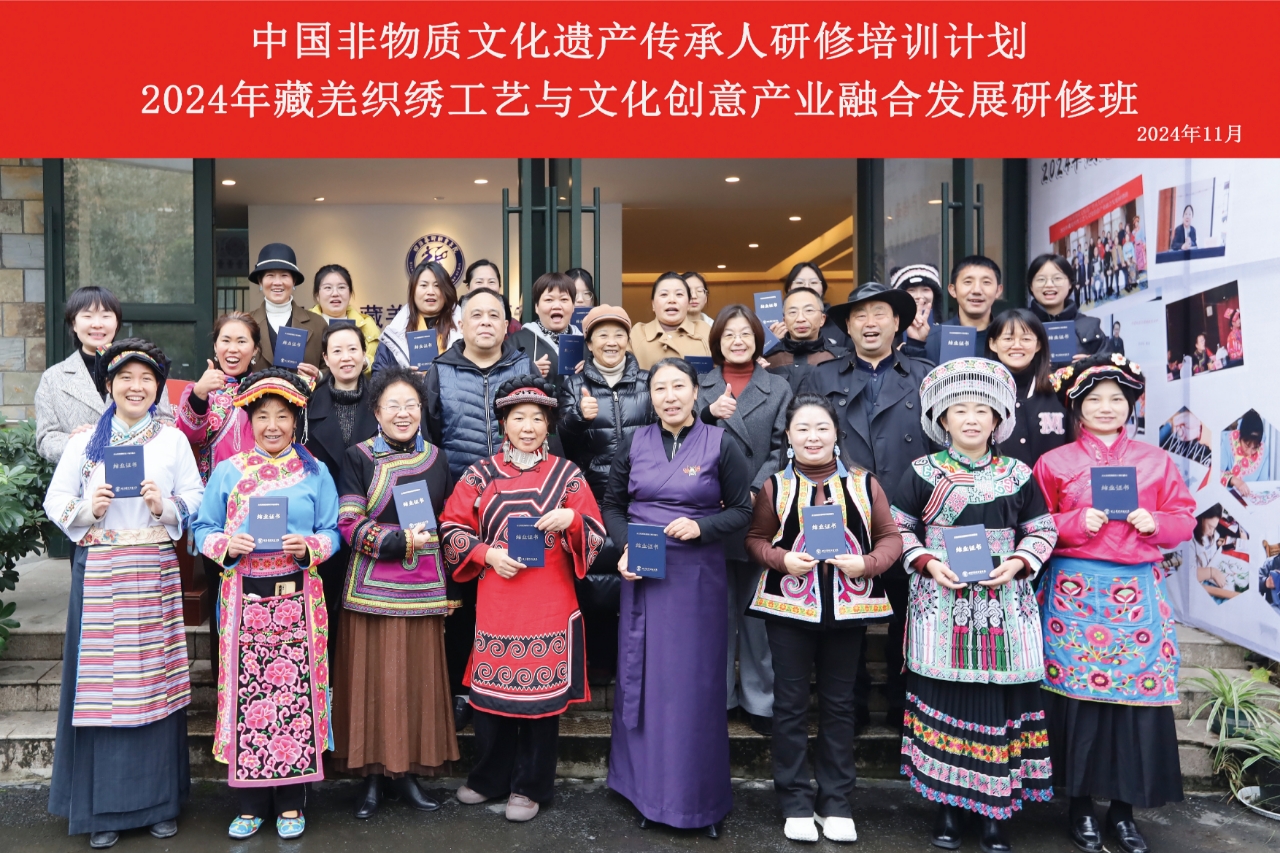
Jointly organized by the Ministry of Culture and Tourism, the Ministry of Education, and the Ministry of Human Resources and Social Security of China, this one-month intensive program was hosted by Sichuan Vocational College of Art and implemented by the Yang Huazhen Tibetan & Qiang Embroidery Master Studio.
Launched on October 28, the program adopted a fully immersive format combining classroom teaching, hands-on embroidery practice, field visits, artistic creation, seminars, and final showcases. A highlight of the program was direct instruction from national-level Intangible Cultural Heritage (ICH) inheritors, including Master Yang Huazhen, a renowned expert in Tibetan weaving and Qiang embroidery.
Twenty ICH practitioners and artisans from across various cities and prefectures participated in the training. These dedicated individuals—active in Tibetan-Qiang embroidery and traditional Chinese “tiaohua” stitching—engaged enthusiastically in both technical and conceptual learning. Through the program, they deepened their embroidery skills, enhanced their artistic sensibilities, and broadened their perspectives, laying a stronger foundation for their continued contribution to cultural heritage preservation and industry innovation.
This training initiative represents a key effort in implementing China's ICH preservation policies. It contributes to revitalizing traditional culture, enhancing the living transmission of embroidery heritage, and cultivating a new generation of talent to carry forward the Tibetan and Qiang embroidery traditions. Moreover, by promoting the integration of traditional craftsmanship into contemporary economic models, the program supports cultural industry development, rural revitalization, and sustainable economic growth—demonstrating the enduring relevance and value of intangible heritage in today's world.